Chapter 01
The Story
In 2000, British racing aficionados voted Nijinsky as their Horse of the Millenium. It was a tremendous honor considering that so many great horses have made their mark on the British horse racing scene over the last century. But the 2000 poll conducted by the Sun newspaper spoke loud and clear -- Nijinsky was the horse the people loved the most.
It's easy to say that Nijinsky was pegged for greatness at birth. As the son of two winners of the prestigious Queen's Plate race (Northern Dancer and Flaming Page), Nijinsky had an excellent gene pool in his favor. But his amazing performances over a sterling 13-year span would clearly mark Nijinsky as one of the greatest of the greats.
Chapter 02
Rise to Greatness
Incidentally, the name Nijinsky II was recorded simply for registration purposes. To his legion of fans around the world, he was known simply as the one and only Nijinsky.
During his standout career, Nijinsky blazed a trail like no other horse before him. He was the first horse to win the coveted English Triple Crown in 35 years, after capturing the Epsom Derby, St. Leger Stakes and the Two Thousand Guineas in 1970. That same year, Nijinsky was honored as Europe's Horse of the Year. He also shattered the European Earnings record after winning $677,177, Nijinsky was later syndicated for a world record sum of $5.4 million.
In 1969, Nijinsky began his career as two-year-old in Curragh, Ireland, where he won the Erne and Railway Stakes, followed by the Anglesey Stakes and finally the Beresford Stakes to cap his career as a two-year-old. With his victories, Nijinksy was heralded as the two-year-old champion of both Ireland and England.
Chapter 03
Defining Performances
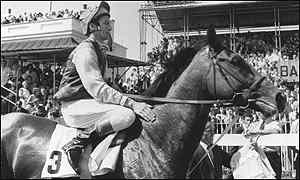
He also began his career as a three-year-old in Curragh where he won the Gladness Stakes. He followed this up with the Two Thousand Guineas to capture the first jewel of the Triple Crown. His next two races were easy victories for the muscular thoroughbred as he left the field eating his dust in the English Derby and the Irish Sweeps Derby. The prestigious King George VI and Queen Elizabeth Stakes in Ascot came next, where Nijinsky faced an elite and older field that included the 1969 Epsom Derby winner, Blakeney. Despite that, Nijinsky would defeat this heralded field and, with his jockey, Lester Piggott, would gain consideration as the most formidable horse and jockey combo ever.
An attack of ringworm after that victory left Nijinsky inactive for a significant period. Despite that, Nijinsky captured the St. Leger Stakes upon his return to complete the Triple Crown, the first to do so since Bahram accomplished the feat 35 years earlier.
Chapter 04
Defining Performances
In the world-famous Prix de lArc de Triomphe in Paris, Nijinsky would suffer his first defeat, losing by a head by Sassafras. Many pundits blamed his jockey, Piggott, for what critics claimed was a sloppy performance. However, in his final race, the Champion Stakes, Nijinsky would again finish second, signaling the fact that the end had arrived for the champion colt.
After his retirement, Nijinsky was assigned as a stud at the Claiborne Farm in Kentucky, with his owners earnestly hoping that the great horse could pass on his strength, stamina and incredible will to win.
In 1970, a film was released commemorating Nijinsky's brilliant racing career. Orson Welles was the film's narrator. The film was later released in VHS video format in 1988.