Chapter 01
The Story
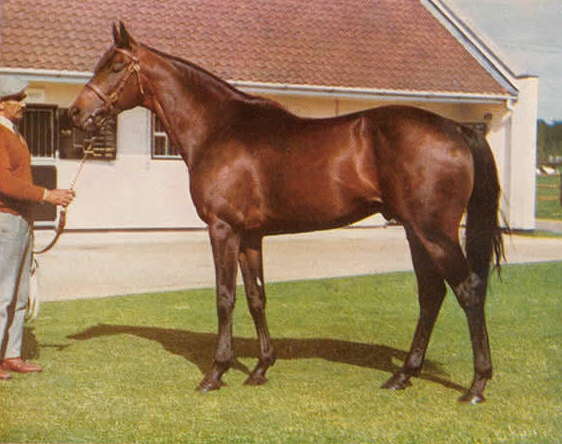
When it came to middle-distance races, very few thoroughbreds can hold a candle to Mill Reef, one of the UK's best-ever champions. He is ranked as number four in the list of Top 100 European Racehorses of the 20th Century, compiled by Racing Post.
In addition, Mill Reef has been honored as the UK's Three-Year-Old champion and Europe's Horse of the Year in 1971. In 1972, Mill Reef was awarded as the UK's Champion Older Horse. Later in life, Mill Reef also made his mark as a sire and was recognized as the Leading Sire in the UK and Ireland in 1978 and 1987.
Chapter 02
Rise to Greatness
Moreover, to commemorate Mill Reef's racing exploits, a life-size bronze statue in his honor was erected at the National Stud in Newport. The Mill Reef Stakes in the UK's Newbury Racecourse was also named in the horse's honor.
Born in 1968, Mill Reef first made his mark as a two-year-old by winning five of his six races in 1970. His winning ways began in his inaugural race, the Salisbury Stakes, where he defeated Fireside Chat, the reigning champion and a 2-9 favorite, by four lengths. This was followed by victories at the Coventry Stakes in Royal Ascot, which he won by four lengths. He was then brought to France for the Prix Robert Papin, but traveling to a foreign land took its on Mill Reef, and he suffered a close defeat to My Swallow.
Returning to the UK, Mill Reef showed his resilience by winning his last three races of 1970 -- the rain-drenched Gimcrack Stakes, the Imperial Stakes, and the prestigious Dewhurst Stakes By end-1972, Mill Reef was ranked as the third-best two-year-old, behind undefeated Brigadier Gerard and My Swallow, the horse that handed him his only defeat.
Chapter 03
Defining Performances
Mill Reef started the 1971 season by winning the Greenham Stakes before falling to second place behind another elite three-year-old, Brigadier Gerard, in the Two Thousand Guineas. His old rival, My Swallow, finished third in that race.
As he did in the previous year, Mill Reef would bounce back from a defeat by notching a streak of victories. He would stamp his class on middle-distance races by winning three prestigious events in dominating fashion. He emerged as champion at the Epsom Derby (by two lengths), the Eclipse Stakes (by four lengths), and the King George & Queen Elizabeth Stakes (by six lengths).
Chapter 04
Defining Performances
Mill Reef would cap his successful campaign in 1971 by capturing the title at the Prix de l'Arc de Triomphe in France against a field that featured some of Europe's elite thoroughbreds. With that victory, Mill Reef became the first horse to ever win the Arc, King George and Eclipse trifecta.
In 1972, Mill Reef would win the Prix Ganay and the Coronation Cup before he was diagnosed with a virus. When he returned to compete at the Prix de l'Arc de Triomphe, he shattered his foreleg during practice. And, although he would recover from that as well, his racing career had come to an end. Overall, he had competed in 14 races, winning 12 of them.
Mill Reef became a very successful sire until his death in 1986.